HVAC service agreement pricing: how to build, price and sell maintenance memberships
How much to charge for an HVAC maintenance plan, built from your own costs instead of a guess. What to put in good, better and best membership tiers, a worked pricing example, how techs offer plans without pressure, monthly versus annual billing, renewals, and how a membership book smooths the slow months.

By The Revcore team
Reviewed by Hayden Mitchell, founder
12 min read
Quick answer
How much should an HVAC company charge for a maintenance agreement?
Price an HVAC maintenance agreement from your own costs, not a competitor's number. Add up the loaded labor, drive time and materials for each visit, multiply by visits per year, add the cost of member discounts and payment fees, then divide by one minus your target margin. Offer it monthly and annually, in two or three tiers.
Most HVAC shops already know memberships are worth having. The trouble is the details. The price was set years ago by matching a competitor's flyer, the perks list keeps growing, half the members are on a paper sheet in the office, and nobody is sure whether the plan makes money or just fills the schedule in April.
This guide covers tiers, pricing from your own costs, how techs offer plans, billing, renewals and seasonality. Every dollar figure below is an illustrative example unless it carries a source link. Plug in your own numbers.
What an HVAC maintenance membership should include
A membership is a promise to do the maintenance on schedule, plus a few benefits that make being a member feel different from being a customer. Start with the visits, because they are the part that actually protects the equipment.
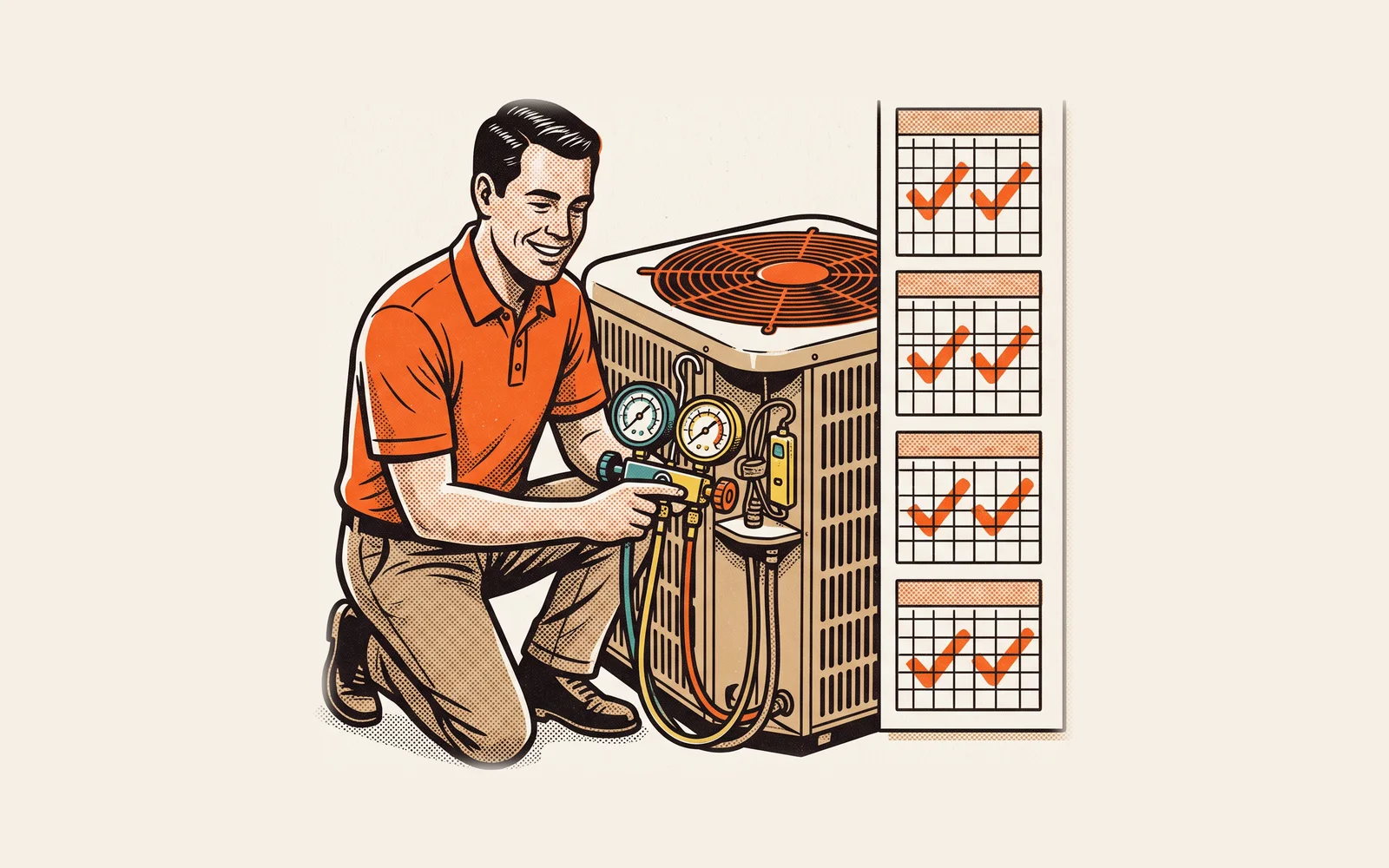
ENERGY STAR's maintenance checklist recommends a pre-season check of the cooling system in spring and the heating system in fall, and lists what a typical check-up covers, including tightening electrical connections, lubricating moving parts, checking the condensate drain and controls, cleaning coils, checking refrigerant, and adjusting blower components. It notes that airflow problems can cut a system's efficiency by up to 15 percent. The Department of Energy's air conditioner maintenance guide adds coil fin straightening, leak testing and checking thermostat accuracy. That is a solid, defensible visit checklist, and it gives your techs something concrete to show the homeowner.
Beyond the visits, the benefits that tend to matter to homeowners are the ones that save them time or money when something goes wrong:
- Priority scheduling. Members go to the front of the line on the hottest and coldest weeks. It costs you little and it is the benefit people remember.
- A repair discount. A percentage off repairs is simple to explain. Price it in, because it is a real cost.
- No trip or diagnostic fee. Useful, but only if your pricing already absorbs it.
- Filters supplied at the visit. A small, tangible perk for a higher tier.
- Accessory service. Humidifiers, air cleaners and UV lights checked on the same visit.
- A discount on additional systems. Homes with two systems should not pay double.
Good, better, best membership tiers
Three tiers do the same job on memberships that they do on good, better, best install quotes. The homeowner stops deciding whether to join and starts deciding which plan fits. Keep the visit checklist the same in every tier so the maintenance is never the thing you trim. The tiers differ by perks.
| Good: Essential | Better: Comfort | Best: Premier | |
|---|---|---|---|
| Tune-ups | Two a year, spring cooling and fall heating | Two a year, spring cooling and fall heating | Two a year, spring cooling and fall heating |
| Scheduling | Standard | Priority on peak weeks | Priority on peak weeks |
| Repair discount | None | 10 percent | 15 percent |
| Trip or diagnostic fee | Standard | Waived during business hours | Waived during business hours |
| Filters | Customer supplied | Customer supplied | Supplied and installed at each visit |
| Accessories | Not included | Not included | Humidifier, air cleaner or UV light checked |
| Example price, monthly | $19 | $24 | $34 |
| Example price, annual | $219 | $279 | $389 |
Better is the plan you recommend and where most members should land, so build it first, then strip perks for Good and add them for Best. Good still has to make money. If it only works by skipping part of the checklist, rebuild it.
How to price a maintenance plan from your costs
The pricing formula is short. The work is in getting honest inputs. Here is the Better plan from the table above, priced from scratch.
Cost one visit
Use your loaded labor cost per tech hour, meaning wage plus payroll taxes, insurance, truck and benefits, not the wage alone. In this illustrative example it is $42 an hour. A tune-up takes an hour on site plus 20 minutes of drive, about 1.33 hours, so labor is $56. Add $12 for coil cleaner, condensate treatment and small parts. One visit costs $68.
Multiply by visits per year
Two visits a year is $136 in direct cost per member.
Price the perks
Priority scheduling costs you little. The 10 percent repair discount does not. If a typical member spends about $250 a year on repairs in your shop, the discount costs $25. Use your own history, and revisit it after a year of member data. Direct cost is now $161.
Apply your target margin
For a 40 percent gross margin, divide cost by 0.60. $161 divided by 0.60 is about $268 a year. Use a markup and margin calculator so you do not confuse markup with margin.
Add payment fees and round
At Revcore's published card rate on the payments page, 3.65 percent plus 30 cents, one annual charge of $279 costs about $10.48. Twelve monthly charges of $24 ($288 a year) cost about $14.11. That leaves roughly a 38 percent margin on annual and 39 percent on monthly. Round to $279 a year or $24 a month.
| Line | Annual billing | Monthly billing |
|---|---|---|
| Two tune-ups at $68 | $136.00 | $136.00 |
| Repair discount, 10 percent of $250 | $25.00 | $25.00 |
| Card fees | $10.48 (one charge) | $14.11 (twelve charges) |
| Total cost | $171.48 | $175.11 |
| Price | $279.00 | $288.00 ($24 a month) |
| Gross margin | About 38 percent | About 39 percent |
Two things fall out of this. First, the monthly price should be a little higher than the annual price divided by twelve, because twelve charges cost more to process and monthly members cancel more easily. Second, the margin on the plan itself is only part of the return. The bigger payoff is what members buy later: the repairs they call you for instead of a competitor, and the replacement you get to quote when the system finally ages out.
How techs offer memberships without pressure
Most memberships are sold by the tech in the driveway, not by the office. Homeowners can tell the difference between a tech who is reading a script and a tech who is telling them what their system needs. The second one sells more plans and gets invited back.
Do the work first
Offer the plan after the repair or tune-up is done, not while the homeowner is still waiting on a diagnosis. Nobody wants a sales conversation while the house is 85 degrees.
Show what you found
Walk the homeowner through the photos: the dirty coil, the weak capacitor, the clogged drain line. Tie the plan to this system, not to a brochure.
Explain the plan in one sentence
"Two visits a year, we get to you first when it is 100 degrees out, and repairs are 10 percent off." If it takes a paragraph, the plan is too complicated.
Show the tiers on the same screen as the invoice
Put the plan options next to today's invoice. If today's repair would have been cheaper as a member, show that difference honestly.
Ask once, then let it go
Ask if they would like to join. If the answer is no, thank them, leave it on the record, and let the office follow up with a single text later. A second hard ask in the driveway costs you the next service call.
Memberships also belong in install quotes. A plan in the top tiers of a replacement proposal keeps the new system maintained and keeps you in touch with the homeowner for years. The HVAC install sales process covers how to build that into the options.
Billing: monthly versus annual
Both work. The right answer for most shops is to offer both and let the homeowner pick.
| Monthly | Annual | |
|---|---|---|
| Easier to say yes to | Yes, a small number feels like a utility bill | Harder, the full amount is due up front |
| Cash up front | Spread across the year | Collected at signup or renewal |
| Processing fees | Higher, twelve charges | Lower, one charge |
| Failed payments | More chances for an expired card | One chance a year, but a bigger miss |
| Cancellation | Easier to drop mid-year | Committed for the term |
| Admin | Fine if billing is automatic, painful if it is manual | Simple either way |
The one rule that matters: never bill memberships by hand. A plan billed by sending twelve invoices a year will slowly fall apart as cards expire and invoices go unpaid. Store the card on file at signup with the homeowner's clear consent, charge it automatically on the cadence you agreed, and send a receipt every time. Revcore service agreements handle this for you. Some shops also offer quarterly or semiannual billing to match the visit schedule. For the payment side in general, see getting paid on the day of the job.
Renewals and auto-renewal rules
The first year of a membership is the expensive one to win. Every renewal after that is revenue you already earned. Renewals are mostly a function of whether the member actually got their visits, so the most important renewal step happens months earlier: the visits get scheduled and done.
- Schedule visits automatically. Put the next tune-up on the calendar as soon as the last one closes, and send appointment reminders.
- Remind before you renew. Send a note before the renewal charge with the price, the date and how to cancel.
- Show the member what they got. A short summary of visits done and repairs discounted makes the renewal feel earned.
- Follow up on lapses once. A single, friendly text after a failed renewal recovers more than silence. See follow-up texts that work for the tone.
Auto-renewal is regulated in some states. California's automatic renewal law (Business and Professions Code sections 17600 to 17606), for example, requires that auto-renewal terms be presented clearly and conspicuously before signup, that the business get the consumer's affirmative consent before charging, and that it provide an acknowledgment with the terms, cancellation policy and how to cancel. Other states have their own versions, and the rules vary. Write your terms plainly, get a signature, and keep the record.
How memberships smooth seasonal revenue
HVAC revenue follows the weather. Summer and winter peaks bring more calls than you can run, and the shoulder months leave techs waiting on the phone. ENERGY STAR's checklist makes the same point from the homeowner's side: contractors get busy once summer and winter come, so check cooling in spring and heating in fall. Memberships do two things about that.
First, the billing is flat. As an illustrative example, 400 members at $24 a month bring in $9,600 every month whether the phone rings or not. Second, the visits land exactly where you need work: the spring and fall shoulder weeks. You fill the slow weeks with scheduled tune-ups, and those tune-ups surface repairs and aging systems that turn into work later.
Frequently asked questions
What should an HVAC maintenance plan include?
At minimum, two tune-ups a year, cooling in spring and heating in fall, following a written checklist such as the one ENERGY STAR publishes. Then add a few benefits you can reliably deliver, such as priority scheduling, a repair discount, waived trip fees or filters supplied at the visit. Keep the checklist the same across tiers and vary the perks.
Should I bill memberships monthly or annually?
Offer both. Monthly billing is easier for homeowners to accept and spreads cash across the year, while annual billing brings cash in up front with fewer processing fees. Price monthly slightly higher than the annual price divided by twelve to cover the extra charges and the higher chance of cancellation, and always bill a card on file automatically.
How do techs offer plans on service calls?
After the work is done, the tech shows the homeowner what they found, explains the plan in one sentence, and shows the plan options next to today's invoice. They ask once and accept a no. A single follow-up text from the office later is fine. Pressure in the driveway costs you the next service call.
How do renewals work?
Most shops use auto-renewal: the agreement renews on a set date and the card on file is charged. Present the renewal terms clearly at signup, get the homeowner's consent, remind them before the renewal charge, and make cancelling straightforward. Auto-renewal rules vary by state, so have your agreement reviewed locally.
Is a service agreement the same as a membership?
Usually yes. Both describe a recurring plan where the homeowner pays on a schedule and receives a set number of maintenance visits plus some benefits. Shops use names like maintenance plan, comfort club or membership because they are easier for homeowners to remember than service agreement.
Further reading: ENERGY STAR's HVAC maintenance checklist and the Department of Energy's air conditioner maintenance guide are good sources for your visit checklist. For the offer itself, see good, better, best pricing, and for software built for HVAC shops, see the best HVAC software.
Written by the Revcore team. Reviewed by Hayden Mitchell, founder of Revcore Pro, who closed $3.5M of home improvement door to door and helped scale a contractor from $1M to $10M.