Good, better, best pricing for contractors: how to build three options that close more jobs
One price gives the homeowner a yes or no decision. Three options turn it into a which one decision. Here is how to build the tiers, price the middle, present them at the kitchen table, and use them on service calls too, with worked examples for roofing, HVAC and bathrooms.

By The Revcore team
Reviewed by Hayden Mitchell, founder
Updated 10 min read

Quick answer
What is good, better, best pricing for contractors?
Good, better, best pricing means quoting every job as three complete options instead of one price. Good is the honest minimum, Better is the version you would recommend, and Best is the premium version. The homeowner stops asking whether to hire you and starts choosing which option fits, which usually protects your close rate and raises the average job.
Most contractors quote one number. They scope the job, total it, and hand over a price. It feels simple and honest, and it quietly costs work. With a single price the homeowner has exactly one comparison to make: your number against the option of spending nothing and thinking it over. Thinking it over is where good jobs go to die.
Three options change the shape of that decision. The question is no longer whether to hire you. It is which version of the job makes the most sense for this house and this budget. That is a much easier question to answer while you are still sitting at the table.
What each tier is for
Good, Better and Best are not three random price points. Each tier has a job, and when you build them on purpose the structure does a lot of the selling for you.
| Tier | What it includes | Its job in the conversation |
|---|---|---|
| Good | The core work done properly, standard materials, standard warranty. | A real, deliverable option for the tight budget. It also makes Better look reasonable. |
| Better | The upgrades that genuinely improve the result and that you would recommend to family. | Where most homeowners should land. It carries your best margin and your reputation. |
| Best | Premium materials, the longest warranty, the extras some homeowners truly want. | The ceiling. Few pick it, and its main job is to make Better feel grounded. |
The part most people miss is that the top tier is not mainly there to sell. It is there to reframe everything below it. A $14,000 job looks expensive sitting alone on a page. Sitting next to a $19,000 option, the same job looks careful and fair.
How to build the three tiers without padding
The fastest way to ruin good, better, best is to invent upgrades just to fill a column. Homeowners can tell, and once they smell padding they discount everything else you say. The difference between tiers should be scope, materials and warranty, never gimmicks.
Build Better first
Write up the job you would do on your own house: the materials you trust, the details you would not skip, the warranty you actually stand behind. This is your recommendation.
Strip it down to Good
Remove the upgrades, use the standard material, shorten the warranty to the manufacturer baseline. Good must still be work you are proud of. If you would not install it, do not offer it.
Build it up to Best
Add the premium material, the extended warranty, and the extras a particular homeowner might genuinely value. Best is where you put the things you rarely get to sell but love to install.
Check your margin on every tier
Price each tier from cost plus your target margin, not from what feels right. Good should still be a profitable job, just a smaller one. Use a markup and margin calculator so a discount never slips below your floor.
Space the prices on purpose
The step from Good to Better should feel modest, and the step to Best should feel like a real stretch. A workable starting point is Better roughly 25 to 40 percent above Good, and Best a similar step above Better. Adjust by trade and by what the upgrades actually cost you.
Worked examples by trade
The numbers below are illustrative examples to show the structure, not market prices. Your costs, region and materials will move them. What matters is how the tiers differ and why.
Roof replacement
| Good | Better | Best | |
|---|---|---|---|
| Shingle | Standard architectural shingle | Upgraded architectural line | Premium designer shingle |
| Underlayment | Standard synthetic | Synthetic plus ice and water at eaves and valleys | Full ice and water coverage where your climate warrants it |
| Ventilation | Match existing | Ridge vent and balanced intake | Ridge vent, balanced intake, attic check |
| Warranty | Manufacturer standard | Extended manufacturer system warranty | Top-tier system warranty plus workmanship years |
| Example price | $14,000 | $17,500 | $22,000 |
HVAC system replacement
| Good | Better | Best | |
|---|---|---|---|
| Equipment | Single-stage system that meets code | Two-stage system, quieter and more even | Variable-speed system with the best comfort control |
| Thermostat | Standard programmable | Smart thermostat | Communicating thermostat matched to the system |
| Air quality | Standard filter | Upgraded media filter | Media filter plus air quality add-on |
| Maintenance | None included | First year of tune-ups | Multi-year service agreement |
| Example price | $9,800 | $12,900 | $16,500 |
Bathroom remodel
| Good | Better | Best | |
|---|---|---|---|
| Shower | Acrylic surround | Tile surround, standard layout | Tile to ceiling with niche and bench |
| Vanity | Stock vanity | Semi-custom vanity, quartz top | Custom vanity, upgraded fixtures |
| Floor | Luxury vinyl | Porcelain tile | Porcelain tile with heated floor |
| Example price | $16,000 | $22,000 | $31,000 |
How to price the middle option
Better is the tier most homeowners should choose, so it deserves the most thought. Price it from your costs and your target margin, then sanity check it against how the homeowner will see the jump from Good.
- Anchor on value, not on the cheapest tier. Better should be the price of doing the job right, not Good plus a random markup.
- Make the upgrades visible. A quieter system, a longer warranty, a better shingle line: name the difference in words the homeowner cares about.
- Keep your best margin here. Because Better is the common choice, it is where your margin does the most work across a year of jobs.
- Protect Good's margin too. A cheap tier that loses money is not an option, it is a trap you set for yourself.
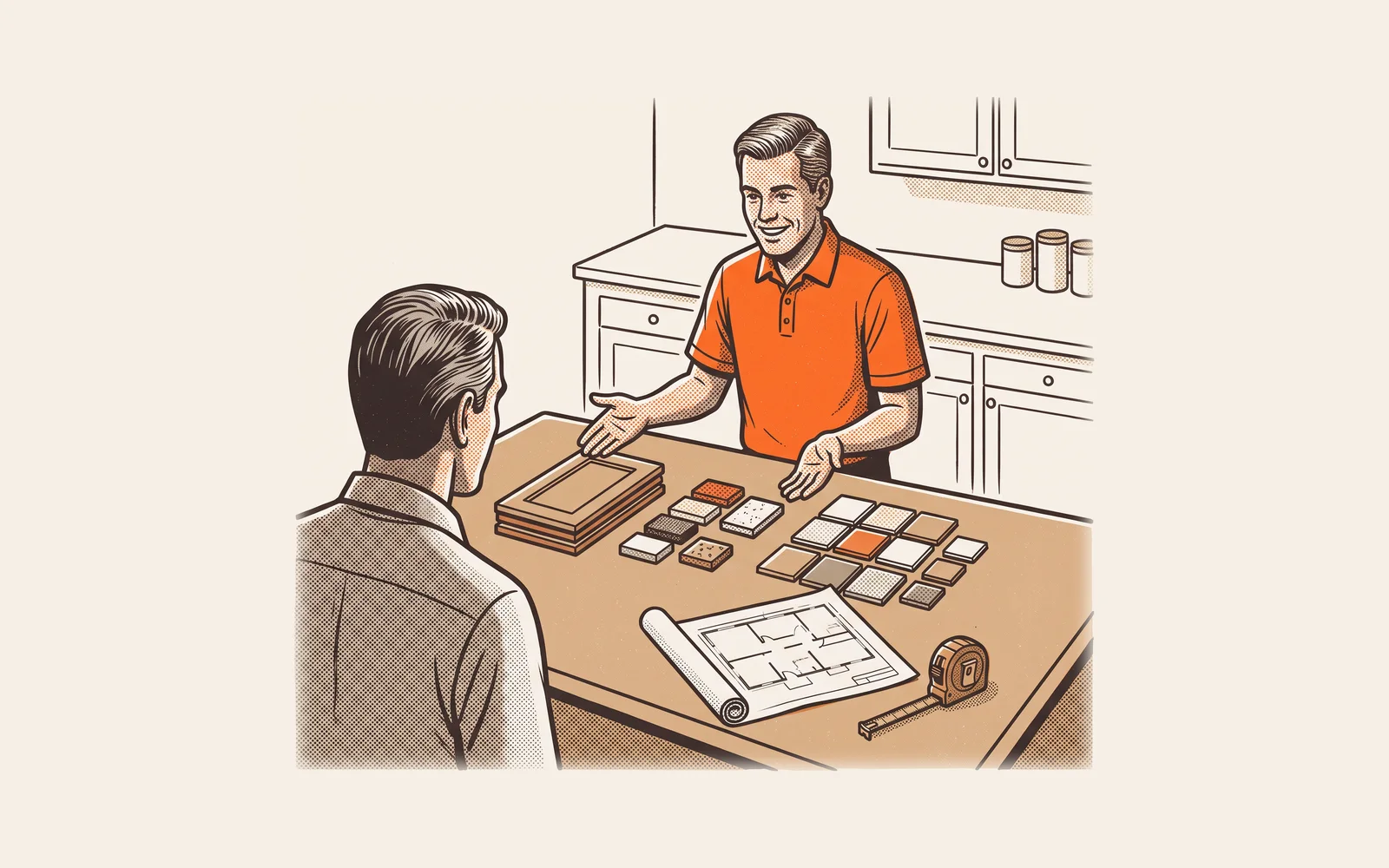
How to present three options at the kitchen table
How you walk through the options matters as much as the options themselves. The most common mistake is leading with the cheapest one, which anchors the whole conversation low.
Recap what you found
Before any prices, walk back through the photos and notes from the inspection. The homeowner should agree on the problem before they see a solution.
Lead with Better
Describe the option you recommend and why you would choose it for this house. Say plainly that it is your recommendation.
Show Good as the trimmed version
Explain what comes out to reach the lower price and what that means for them. Keep it honest and without pressure.
Show Best as the no-compromise version
Explain what the premium adds. Some homeowners want it, and they should get to choose it.
Ask which one fits
Stop talking and ask which option makes the most sense for them. If they pick one, take the signature and the deposit while you are both still at the table.
Why three options protect your close rate
It is easy to assume tiered pricing only raises the average ticket. The bigger effect is often on close rate. A single price forces a fragile decision, and fragile decisions get postponed. Three options give the careful homeowner a real way to say yes without feeling they overpaid, and give the homeowner who wants the best a clear way to spend more. You stop losing the cautious buyer to no decision at all.
There is a second, quieter effect. When the homeowner picks a tier, they made the buying decision themselves. People defend their own choices. A homeowner who chose Better is less likely to call back the next day asking for a discount than one who felt cornered by a single number.
Good, better, best on service calls
Options are not only for big installs. Service and repair calls are a natural fit, and they are where many shops leave the most money on the table because the tech quotes the smallest fix and leaves.
| Option | What it covers | Who it suits |
|---|---|---|
| Repair | Replace the failed part and test. | The homeowner who needs it working today on the smallest spend. |
| Repair plus prevention | The repair, a flush, and a check of the parts most likely to fail next. | The homeowner who wants fewer surprises this year. |
| Replace | A new unit sized for the household, with a longer warranty. | The homeowner with an older unit who wants to stop paying for repairs. |
Mistakes that make good, better, best backfire
- Padding tiers with fake upgrades. It reads as a sales trick and drags down trust in the whole estimate.
- Too many options. Three is the point. Five tiers turn a decision into homework.
- Leading with the cheapest. It anchors the conversation at the bottom of your range.
- A Good tier you would not install. If it is not work you are proud of, do not offer it.
- Retyping every estimate. If building three options takes an hour, your team will stop doing it. Build tiers once in a catalog and reuse them.
Frequently asked questions
How do I price the middle option?
Price Better from your costs and target margin as the job you would recommend, then check that the step up from Good feels modest to the homeowner. Keep your strongest margin in Better, because it is the option most people choose.
Should the cheapest option still be profitable?
Yes. Good should be a smaller job, not a losing one. If a tier only works by cutting corners or losing money, remove it or rebuild it.
Does good, better, best work on service calls?
Yes. Repair, repair plus prevention, and replace are three honest options on most service calls, and they help techs stop quoting only the smallest fix.
How many options is too many?
More than three usually slows the decision down. Three options give a real choice without turning the estimate into homework.
Which option should I show first?
Show the one you recommend, usually Better, then show Good as the trimmed version and Best as the premium version. Leading with the cheapest anchors the conversation low.
Further reading: Jobber's good, better, best pricing guide and ServiceTitan's guide to good, better, best HVAC proposals cover the same idea from their angle. For the presentation itself, see what an in-home sales presentation is.
Written by the Revcore team. Reviewed by Hayden Mitchell, founder of Revcore Pro, who closed $3.5M of home improvement door to door and helped scale a contractor from $1M to $10M.