Speed to lead for home services: how fast to answer a new lead, and how to do it every time
The contractor who answers first often books the estimate. Here is how fast to respond, what to do about missed calls and after-hours leads, who should own the first reply, a playbook by lead source, and how to measure response time so it stays fast in your busiest month.

By The Revcore team
Reviewed by Hayden Mitchell, founder
11 min read
Quick answer
How fast should a home service contractor respond to a new lead?
Aim to reply to every new lead within five minutes during business hours, with a real next step such as two appointment times. After hours, send an instant acknowledgement and a full reply first thing in the morning, unless it is an emergency trade. Automate the first reply so speed never depends on who is free.
A homeowner with a leaking ceiling or a furnace that quit does not fill out one form. They fill out two or three, call the first number that looks credible, and book whoever gives them a time first. You paid the same for that lead as the company that won it. The only difference was the clock.
Most contractors already know speed matters. The problem is that it is nobody's job. The owner is on a roof, the office is on another call, the form notification lands in an inbox nobody watches after 4 p.m., and the voicemail waits until tomorrow. None of that is laziness. It is a missing system.
This guide is that system: how fast to respond, what to do with missed calls and after-hours leads, who owns the first reply, a playbook for each lead source, the steps to set up an instant response, and how to measure it. For the exact words to send once you are fast, see five follow-up texts that turn cold leads into jobs.
What speed to lead actually measures
Speed to lead is the time between a homeowner reaching out and your first reply that moves the job forward. The clock starts when the form is submitted, the call rings or the text arrives. It stops when the homeowner gets a response from your company that confirms the request and offers a next step.
Two details matter. First, an email notification to your office is not a response. The homeowner has to receive something. Second, a response with no next step barely counts. "Thanks, we'll be in touch" stops the clock on paper and leaves the homeowner free to keep shopping. "Can we come Tuesday at 10 or Wednesday at 2?" gives them a reason to stop.
How fast is fast enough
Jobber's 2026 Home Service Trends Report, based on a survey of 1,050 home service business owners in December 2025, looked at how quickly pros answer leads and how quickly customers expect an answer.
20%
of pros say they respond to leads within the hour
60%
of pros say they reply to leads the same day
28%
of customers expect an immediate response, per the report
28%
more expect a response within one hour
Put those side by side and the gap is plain. In the report, more than half of customers expect an answer within the hour, while most pros answer the same day. The report also found HVAC was the slowest trade to respond within the hour, at 11 percent. A same-day reply feels responsive from inside a busy shop. From the homeowner's couch, it can mean a competitor already booked the visit.
You do not need a study to set your own target, though. Pick a number your team can hit on a bad day, write it down and measure against it. Here is a reasonable starting point.
| Situation | Target for first reply | What the reply should do |
|---|---|---|
| Form, text or chat in business hours | Within 5 minutes | Confirm the job, name a person, offer two times |
| Missed call in business hours | Text back within 5 minutes, call back within 15 | Say who called back and how to book by text |
| Marketplace or directory lead | As fast as possible, ideally within minutes | Be first with a specific time, not a question |
| Lead after hours, non-emergency | Instant acknowledgement, full reply by 8 a.m. | Set the expectation, then book in the morning |
| Emergency call after hours | A live answer or a callback within your promised window | Triage, give a time, dispatch if you offer it |
What happens to missed calls
A missed call is a lead that already chose you. They did not fill out a form on three sites. They called your number. If it rings out to a generic voicemail, many homeowners will not leave a message. They call the next company on the list.
You cannot answer every call live, especially with a small office. You can make sure no missed call goes unanswered for long. In order of preference:
- Answer live when you can. Route the main line to the office first, then to a second phone before voicemail. Check your phone system's ring order. Many shops find calls ringing a single desk that sits empty at lunch.
- Text back within minutes when you cannot. A short text from your business number, with your name and company, tells the homeowner a person saw the call and gives them a way to book without playing phone tag. Text 3 in our follow-up texts guide is written for this.
- Call back within 15 minutes. The text buys a little time, not a day. Someone still owns the callback.
- Fix the voicemail greeting. Say your company name, that you will text back shortly, and, if you offer it, what to do in an emergency.
- Log every missed call as a lead. If missed calls live only in a phone's recent list, you cannot measure how fast you answer them or how many you lose.
After-hours coverage by trade
Leads keep arriving after you close. Homeowners research at night and on weekends because that is when they are home. The right after-hours plan depends on whether the job is urgent for the homeowner right now.
Emergency trades: plumbing, HVAC, electrical
A burst pipe, no heat in January or a tripped main breaker will not wait until morning, and the homeowner will call until someone answers. If you offer emergency service, you need a live path: an on-call tech with a rotation, or an answering service that follows your triage script and pages the on-call person. If you do not offer emergency service, say so in your greeting and your auto-reply, and give a clear time you will call back. An honest "we open at 7 and will call you first" keeps more leads than silence.
Planned work: roofing, remodeling, exteriors, replacements
A homeowner requesting a roof replacement quote at 10 p.m. wants to know you got it, not a sales call. Send an instant acknowledgement that names your company and says when you will reach out, then send the real first text at 8 a.m. with two appointment times. Make the reply easy, so the homeowner can answer with a single number when they wake up. Keep automated follow-ups inside sensible hours at the homeowner's location, as covered in the after-hours section of our follow-up texts guide.
The exception is storm season. After a hail or wind event, roofing leads spike and every company in town is chasing the same streets. Extending office hours, or adding an evening shift for first response for a few weeks, often pays for itself.
Who owns first response
The most common reason leads wait is not a lack of effort. It is that three people could answer, so each assumes someone else did. Fix it with one rule: in every hour you are open, exactly one named person owns first response.
| Company stage | Who owns it | Backup |
|---|---|---|
| Owner-run, one office person | The office person, with automated replies covering the gaps | The owner, on their phone, for missed calls only |
| An office team of two or three | A named person per shift, set on the schedule | The next person on the schedule |
| A sales team with an inside sales role | The inside sales or booking coordinator | The sales manager, who also reviews the numbers |
| Multiple trades or territories | Leads route to the owner of that trade or area | A central office queue for anything unrouted |
Whoever owns it needs three things: every lead source landing in one place, the authority to book appointments on the calendar, and a clear handoff when they step away. If your owner is still the only person who can book an estimate, that is a hiring signal. See when to hire your first office manager.
A response playbook by lead source
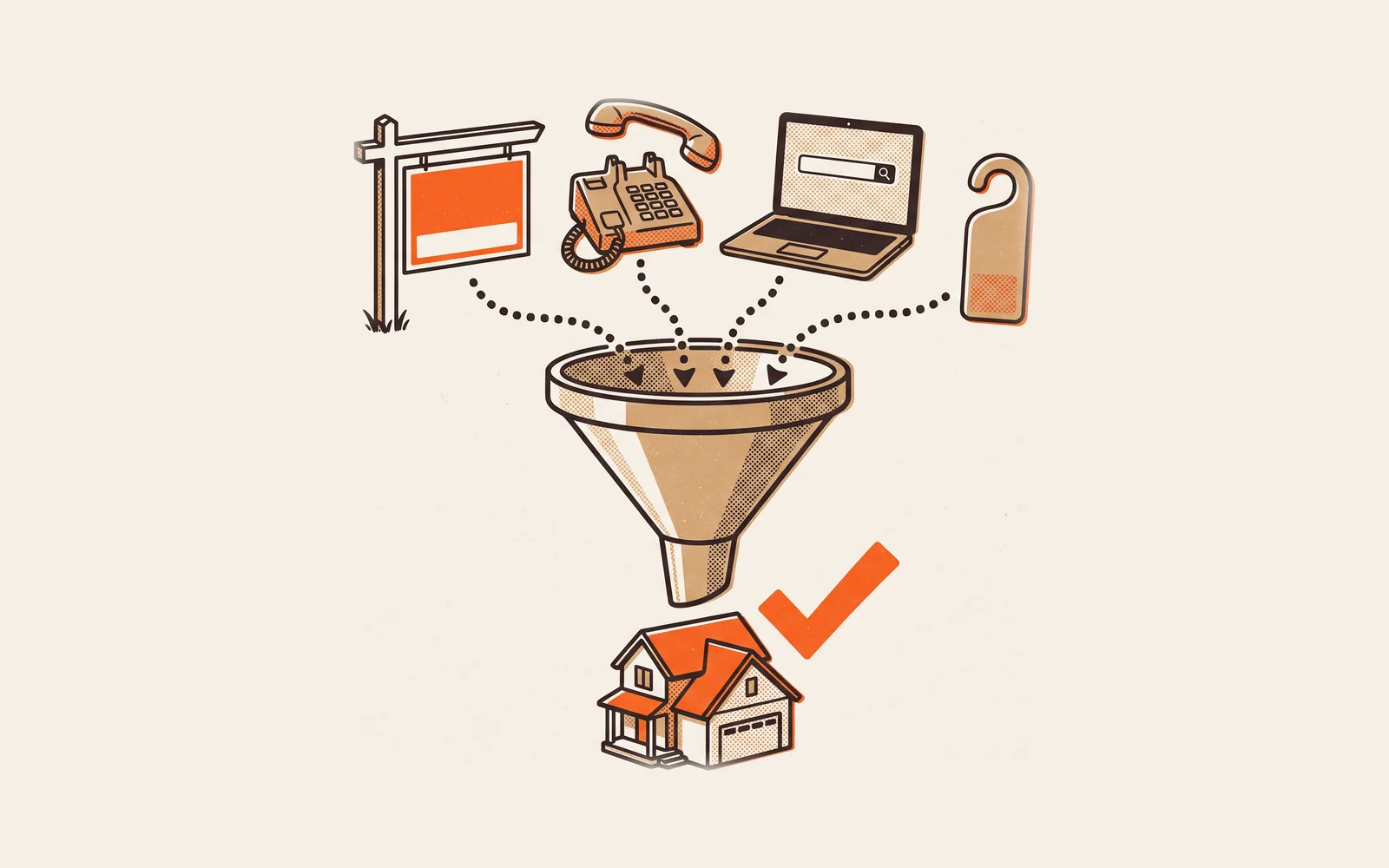
Each lead source arrives with a different homeowner mindset. A caller wants a voice. A form filler often wants to avoid one. A marketplace lead is almost certainly talking to other contractors already. Match the first response to the source.
| Source | What the homeowner expects | First response | Target | Watch out for |
|---|---|---|---|---|
| Website form | A reply without having to call | Automatic text and email with a named person and two times, then a call if they ask for one | Under 5 minutes | Form notifications going to one inbox nobody watches |
| Phone call | A person, right now | Answer live, or text back from your business number and call back | Live, or text in 5 and call in 15 | Voicemail greetings with no next step |
| Inbound text | A text back, not a call | A text from a person with a direct question or two times | Under 5 minutes | Texts landing on a personal phone that is off |
| Marketplace or directory | Several companies to contact them | Text immediately with a specific time, then call | As fast as possible | Treating it like a form and replying tomorrow |
| Referral | A trusted, personal reply | Mention the referrer by name and offer times | Same hour | Assuming a referral will wait |
Marketplace leads deserve extra attention because the homeowner usually knows other companies received the same request. Get them into the same pipeline as your other leads by whatever route your marketplace allows, even if that means someone copies them in by hand, so they get the same fast reply and so you can compare them fairly later.
Worked examples by trade
These are illustrative examples, not real customer stories. They show what a working system looks like on an ordinary day.
- Roofing, a form at 9:40 p.m. The homeowner gets an automatic text naming the company and saying a person will text at 8 a.m. with times. At 8:05 the office lead sends two inspection times. The homeowner books by replying "2".
- HVAC, a missed call at 12:15 p.m. The office is at lunch. Within five minutes the homeowner gets a text from the business number: "Sorry we missed you, this is Dana at the shop. Is your system not cooling, or is this about a replacement quote?" The callback happens at 12:25 with a same-day diagnostic slot.
- Plumbing, an emergency call at 11 p.m. The answering service follows the triage script, confirms active water, and pages the on-call tech, who calls the homeowner within the promised window.
- Remodeling, a directory lead at 3 p.m. The designer who owns the territory texts within minutes with two consultation times this week and a note that a photo of the room helps. The homeowner replies with a photo before the other contractors call.
How to set up instant response
Speed that depends on someone checking their phone disappears the first week you get busy. Set it up once so the first reply goes out on its own, and people take over from there.
List every way leads reach you
Write down each source: website forms, phone, texts, directories and marketplaces, referrals, ads, social messages. Next to each, write where it lands today and who sees it first.
Send every lead to one pipeline
Forms, texts and marketplace leads should all become records in the same CRM, with the source attached. If a lead only lives in an inbox or on a phone, you cannot answer it fast or measure it.
Turn on an automatic first reply
For forms and texts, send an instant text and email that names your company and a person, confirms the job and offers a clear next step. Write it like a person, not a ticket confirmation.
Route each lead to its owner
Assign leads by trade, territory or shift so one named person gets the notification and the task. Add a backup rule for anything that sits untouched.
Cover missed calls and after hours
Set your ring order, fix the voicemail greeting, and decide who texts back missed calls. Write your after-hours auto-reply and, for emergency trades, your on-call or answering service plan.
Load your follow-up sequence
The first reply is only step one. Schedule the next texts for leads who do not answer, and stop the sequence the moment a homeowner replies. Our five follow-up texts are a ready starting point.
Test it like a homeowner
Submit your own form at 9 p.m., call your main line at lunch and text your business number on a Saturday. Time each response. Repeat every quarter, and after any change to your website or phone system.
How to measure response time
If you do not measure it, speed to lead slides back to same-day the first busy month. Track a few numbers, review them monthly, and break them out by source and by person.
- Median time to first reply. Use the median, not the average, so one lead that sat over a holiday weekend does not hide everything else.
- Share of leads answered inside target. For example, the percentage of business-hours leads that got a reply within five minutes. This is the number to put in front of the team.
- Missed calls without a callback. Count calls that never got a text or a call back within your window.
- Booked rate by response time. Compare leads answered in minutes with leads answered in hours. Your own data will show what speed is worth in your market.
- Booked and sold jobs by source. A source that looks weak can be a slow-response problem, not a marketing problem.
That last point is where speed to lead meets your marketing budget. Before you cut a channel, check how fast its leads got a first reply. Our guide to marketing attribution for contractors covers tracking cost per booked job by source and a monthly review that includes response time. And once a lead has an estimate and goes quiet, the job changes. See how to follow up on an unsold estimate.
Mistakes that slow response down
- Leads in five places. Form emails, a directory app, the office phone, a rep's cell and social messages. Nobody can be fast across all of them.
- A first reply with no next step. A thank-you message stops your clock but not the homeowner's shopping.
- Sales pitches at 10:30 p.m. After hours, acknowledge and set a time. Save the real conversation for the morning.
- Business texts on personal phones. When that person is off, sick or leaves, the conversation goes with them.
- Measuring only lead volume. More leads answered slowly can book fewer jobs than fewer leads answered fast.
Replies, reminders and follow-ups all live on the customer's record in Revcore communications, so anyone on the team can pick up the conversation when the first person is busy.
Frequently asked questions
What is speed to lead in home services?
Speed to lead is the time between a homeowner reaching out, by form, call, text or marketplace, and your company's first reply that moves the job forward. Homeowners often contact several contractors at once, so a fast reply with a specific next step, such as two appointment times, often decides who books the estimate.
How fast should a contractor respond to a lead?
Aim for five minutes during business hours on forms and texts, and a text back within minutes on missed calls. Jobber's 2026 Home Service Trends Report found 20 percent of pros respond within the hour, so replying in minutes puts you ahead of most competitors. After hours, acknowledge instantly and reply fully in the morning.
What should I do when I miss a call from a new lead?
Text back from your business number within about five minutes with your name, your company and an easy way to book, then call back within 15 minutes. Log the call as a lead so it is tracked. Fix your ring order and voicemail greeting so fewer calls go unanswered in the first place.
How do I respond to leads after hours?
For planned work like roofing and remodeling, send an instant acknowledgement that says when you will reach out, then text two appointment times at 8 a.m. Make booking a one-word reply, like "1" or "2". For emergency plumbing, HVAC or electrical, use an on-call rotation or an answering service with a triage script.
How do I measure response time?
Get every lead into one pipeline with a timestamp and a source, then track the median time to first reply, the share of leads answered within your target, and booked rate by source. Review the numbers monthly, by source and by person, and test your own forms and phone line every quarter.
Further reading: Jobber's 2026 Home Service Trends Report has the full response time findings by trade. For more leads to answer, see local SEO for contractors, and for what to say once you reply, see five follow-up texts that turn cold leads into jobs.
Written by the Revcore team. Reviewed by Hayden Mitchell, founder of Revcore Pro, who closed $3.5M of home improvement door to door and helped scale a contractor from $1M to $10M.