Contractor dispatch software: a buyer's guide with a feature checklist and demo questions
Dispatch software decides which crew goes where, in what order, and what the homeowner hears before the truck arrives. Here is the feature checklist, the questions to ask in every demo, how install crews and service calls differ, and a morning routine that holds up.

By The Revcore team
Reviewed by Hayden Mitchell, founder
Updated 11 min read
Quick answer
What is contractor dispatch software?
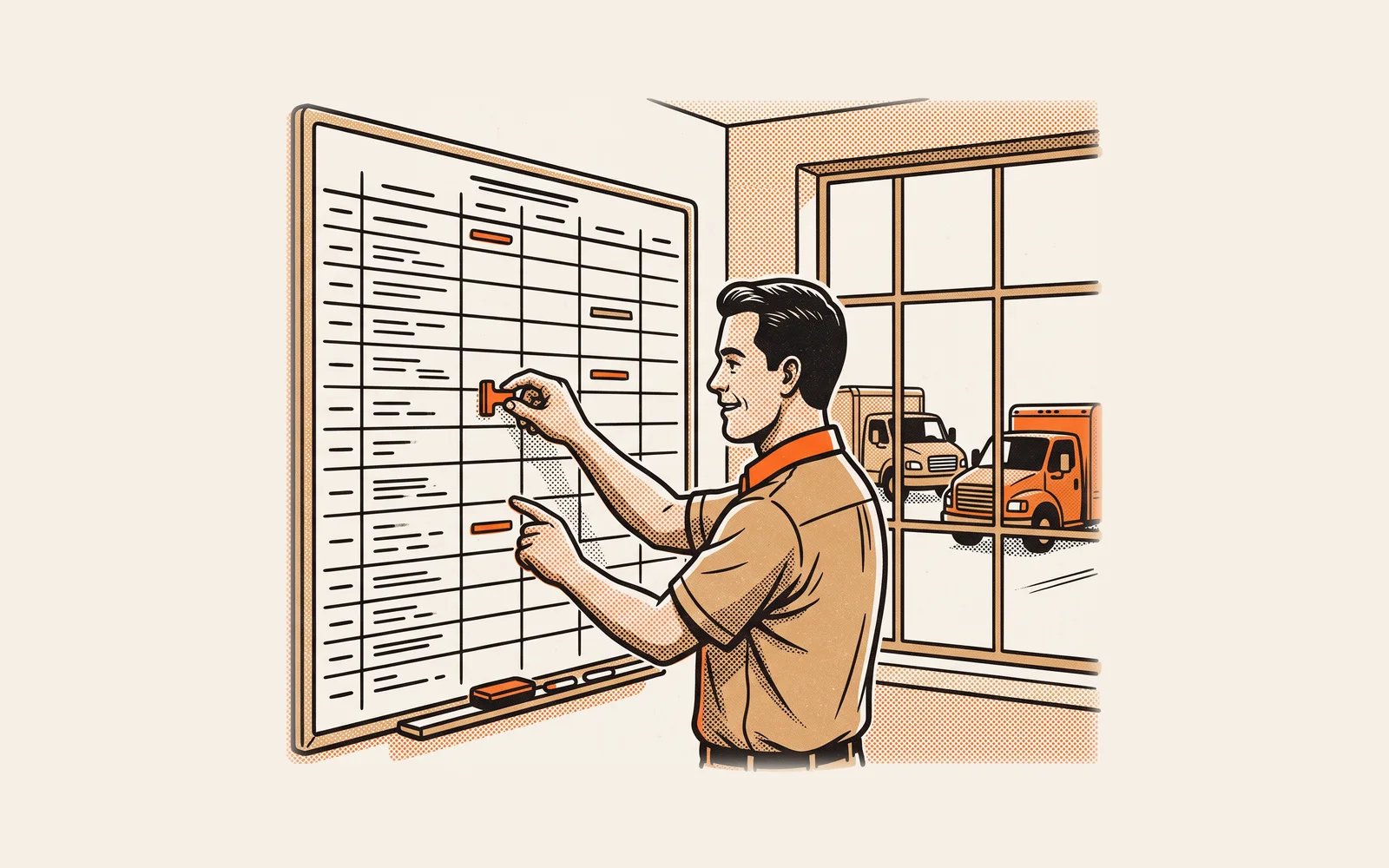
Contractor dispatch software runs the day once the schedule is set. It assigns each job to a crew, orders the stops by drive time, sends job details to the crew's phone, texts the homeowner when the crew is on the way, and records when crews arrive and leave, all on the same job record as the estimate and invoice.
Most contractors do not go shopping for dispatch software on a calm day. They start looking after a week where two trucks crossed town twice, a homeowner called three times asking when the crew would show, and the office spent the morning on the phone instead of booking work. The whiteboard that worked at two crews stops working at five or eight, and the cost shows up as drive time, overtime and missed windows.
This guide is for owners and operations managers at home-service companies doing roughly $2M to $30M a year. It covers a feature checklist for demos, how install crews and service techs differ, the questions that expose a weak tool, and a morning routine that makes any tool work better.
Scheduling vs dispatch: what each one does
The two words get used as if they mean the same thing, and that causes bad buying decisions. Scheduling is the calendar layer: which crew or tech is working which job on which day, and how the week is loaded. Dispatch is the execution layer inside a single day: the order of the stops, the route between them, the text to the homeowner, and the reshuffle when a job runs long or an emergency call lands at 10am.
You need both on the same data. If the office moves a job and the crew's phone still shows the old time, the crew will trust the wrong one. The simplest test: move a job in the office and watch how fast the change reaches the truck.
The contractor dispatch software feature checklist
Use this table as your scorecard in every demo. The last column is how Revcore handles each item, so you can hold us to the same standard.
Swipe the table to see every column.
| Feature | Why it matters | What to test in the demo | Revcore |
|---|---|---|---|
| Scheduling board | One view of every crew and job, so nobody keeps the day in their head. | Show a day and a week for eight crews. Can you read it at a glance? | Crew board with day, week and month views, on every plan. |
| Drag and drop | Moving a job should take seconds, not a delete and re-enter. | Drag a job to another crew and another day. Does the crew's phone update? | Drag a job onto the right crew on the board, on every plan. |
| Job details on mobile | Crews should never call the office for an address, a gate code or the scope. | Open the job on a phone. Are notes, contact info, photos and scope all there? | Crews see their day and job details on their phone and update job status from the field. |
| Route optimization | Stop order drives fuel, overtime and how many calls a tech can run. | Add six stops in random order and optimize. Does it show miles and drive time? | Route optimization on Pro and Scale, with a live crew map and a job map of every site, and crews get directions to the next stop on their phone. |
| On-the-way texts | Most "where is the crew" calls go away when the homeowner gets a heads-up. | Trigger the text. What does the homeowner actually receive? | Automatic "crew on the way" texts, appointment confirmations and reminders, plus two-way texting, on every plan. |
| GPS clock-in and out | Confirms arrival and ties hours to the job for payroll and job costing. | Clock in on a phone. Where do the hours land, and what location is recorded? | GPS clock-in and out at the job, with timesheets. Pro and Scale. |
| Capacity view | You cannot sell next week if you cannot see whether next week is full. | Show the week by crew. Can sales see open capacity before promising a date? | Week view on the crew board to balance load by crew and territory. |
How dispatch differs for install crews and service calls
A roofing company and a plumbing service company both say they need dispatch software, but they are solving different problems.
Swipe the table to see every column.
| Install and project crews | Service calls | |
|---|---|---|
| Typical trades | Roofing, remodeling, siding, windows, HVAC replacements | Plumbing, electrical, HVAC repair, maintenance visits |
| Job length | Half day to several days, one crew on one address | 30 minutes to a few hours, four to eight stops a day |
| What breaks the day | Weather, missing material, a job that runs into day two | Emergency calls, jobs that run long, homeowners not home |
| What the board needs | Multi-day blocks, crew assignments, material readiness notes | Short slots, fast reassignment, stop order by drive time |
| Routing value | Moderate: few stops, but supply house runs and dump trips count | High: stop order decides how many calls a tech can finish |
| Homeowner communication | Start date, day-before confirmation, daily arrival text | Tight arrival window and an on-the-way text with an ETA |
Install crews: protect the start and the materials
For a roofing, siding or remodeling crew, the costly failure is not a longer drive. It is showing up where the material is not there, the dumpster did not land, or the homeowner forgot the start date. Install dispatch is mostly readiness: every job on tomorrow's board has material confirmed, access notes filled in and a confirmation text sent. When rain hits, you push multi-day jobs back cleanly and tell each homeowner without an afternoon of calls.
Service calls: protect the window and the stop order
A plumbing or HVAC service tech running six calls a day lives and dies by stop order. Put the calls in the wrong order and the tech spends an extra hour driving, which is one call they cannot run.
Example, illustrative only: an HVAC tech has six stops spread across a metro area. Entered in the order the calls came in, the route crisscrosses town. Optimized from the tech's starting point, the same six stops form a loop, and the saved drive time is often enough to fit in one more call or send the tech home on time. The numbers depend on your territory, so test it in the demo with a real day of your own addresses.
Service shops also need a clean way to handle the emergency. When a no-heat call comes in mid-morning, the dispatcher should be able to see which tech has room, drag the call onto their day, re-optimize the remaining stops and let the affected homeowners know, all in a couple of minutes.
Questions to ask in every dispatch software demo
Demos show the happy path. Bring a real day of your own jobs and addresses and make the vendor run a bad Tuesday live.
- "Move this job to another crew and show me the crew's phone." You want to see how fast the change lands and whether the crew gets notified.
- "Optimize this day of stops from our shop address." Ask what the tool optimizes for (drive time or distance) and whether you can lock a stop that has to happen at a set time.
- "Send the on-the-way text to my phone." Read it as a homeowner would. Does it name your company, the tech and an ETA? Can the homeowner reply?
- "What does GPS record, and when?" Clock-in location, stops on a map and continuous tracking are different features with different privacy trade-offs for your crews.
- "Show me the job on a phone with no office help." Scope, photos, notes, contact info and access details should all be there.
- "How do recurring visits and maintenance agreements get onto the board?" If a tech has to remember them, they will be missed.
- "Where does the job go after the work is done?" Dispatch that cannot hand the job to invoicing and payment on the same record creates retyping.
- "Which features are on which plan, and what does it cost at our crew size?" Routing, GPS and texting are often on higher tiers or sold as add-ons.
That last question matters more than it looks. As of September 24, 2026, Jobber lists routing and GPS tracking from its Connect plan and crew scheduling on Plus, and charges $29 a month per additional user. Housecall Pro lists routes and employee GPS from Essentials and route optimization on MAX, which is $299 a month billed annually for 8 users plus $35 a month per extra user. ServiceTitan sells Dispatch Pro and Scheduling Pro as separate products and does not publish prices. None of that is bad, but you need the full price for the plan that actually has the features you tested.
Where the leading tools are strong
Be fair to every option on your list. ServiceTitan goes deeper than most tools on large-fleet dispatch, call booking, pricebook and payroll, and it suits established multi-truck operations willing to go through a sales-led quote. Workiz is built around scheduling, dispatch and an integrated phone system, and fits phone-driven, dispatch-heavy service businesses. Jobber and Housecall Pro publish their prices and cover scheduling, routing and invoicing well for smaller service teams.
Revcore is built for contractors who sell higher-ticket work in the home and then run crews to deliver it: CRM, good, better, best estimates, an interactive presentation, scheduling and dispatch, invoicing and instant payouts for 1.5% in one login, on flat plans with unlimited free field crew seats. For a ranked look at the field, see our best dispatch software for contractors roundup, and for head to head detail, compare Revcore vs ServiceTitan, Revcore vs Workiz or Revcore vs Housecall Pro.
A morning dispatch routine that holds up
Software does not fix a messy morning on its own. The shops that get the most from dispatch run the same short routine every day, and the tool just makes each step faster. Here is a routine that works for a five to ten crew operation. We go deeper on the human side in the morning routine that keeps a multi-crew operation on schedule.
Close tomorrow's board the afternoon before
Every job for tomorrow has a crew, a time, confirmed materials and access notes. Send confirmation texts with the arrival window so homeowners who need to reschedule tell you tonight, not at 8am.
Optimize routes before crews arrive
Run route optimization for each service tech from their starting point. Lock any stop with a fixed appointment time first, then let the tool order the rest.
Crews check their day on their phones
Crew leads open their jobs, addresses, sequence and notes. Questions about scope get answered from the job record, not a phone call to the office.
Run a five minute huddle on exceptions only
Tight access, a job that must finish by a set hour, a difficult homeowner, a weather risk. Everything routine is already on the phone, so the huddle stays short.
Crews roll and clock in on arrival
On-the-way texts go to homeowners as each crew heads out, and GPS clock-in at the job tells the office the day started without anyone calling.
Watch the board, not the phone
Through the day, the dispatcher handles exceptions: a job that runs long, an emergency call, a no-show. Drag, re-optimize, notify, move on.
Dispatch is only as good as the job record behind it
Dispatch often goes wrong upstream. If the job was sold in one app and rebuilt in the dispatch tool, details get lost: the color the homeowner picked, the gate code, the upgrade chosen at the table. When the estimate, signed option, photos and schedule share one record, the crew lead sees exactly what was sold.
The same goes for what happens after the work. Photos taken on site protect you against callbacks and disputes, as covered in photo documentation that protects against callbacks. Recurring maintenance visits should land on the board from the agreement itself, which is how HVAC service agreements turn into predictable work.
Signs it is time to replace your dispatch setup
- The office fields more than a handful of "where is my crew" calls a day. Homeowners are not getting on-the-way texts, or the texts are not reliable.
- Crews call the office for addresses, codes or scope. Job details are not reaching the phone.
- Sales promises start dates the crews cannot hit. Nobody can see capacity for next week.
- One person holds the day in their head. If your dispatcher is out sick, the day falls apart. That is also a sign you may need help in the office, covered in when to hire your first office manager.
Frequently asked questions
What is the difference between scheduling and dispatch software?
Scheduling decides which crew works which job on which day and shows how loaded the week is. Dispatch runs a single day: the order of stops, the route, the on-the-way text and the reshuffle when a job runs long or an emergency call comes in. You want both on the same job records so a change in one shows up in the other.
Do small contractors need route optimization?
It depends on the work. Service techs running four or more stops a day usually gain the most, because stop order decides how many calls they finish. Install crews that stay on one address for days gain less from routing and more from a clean board, material readiness and good job notes on the crew's phone.
What should an on-the-way text say?
Keep it short: your company name, the tech or crew lead's name, and an ETA. Send it automatically when the crew heads out so nobody in the office has to type it. A homeowner who knows the crew is coming rarely calls to ask, which frees the office for booking work.
Is GPS clock-in the same as GPS tracking?
No. GPS clock-in records a location when the crew starts and ends work at a job, which confirms arrival and ties hours to the job. GPS tracking follows a phone or vehicle continuously, including between jobs. Ask every vendor which one they mean, and tell your crews what is recorded.
How much does contractor dispatch software cost?
Prices vary widely by vendor, plan and crew size, and routing and GPS features are often on higher tiers. Some vendors publish prices and others require a quote. Revcore has three flat plans, $249, $599 and $1,199 a month with 3, 7 or 15 full seats and free field crew seats, with route optimization, the live crew map and GPS clock-in on Pro and Scale.
Further reading: ServiceTitan's guide to dispatch management software and Housecall Pro's overview of dispatch management cover the same topic from their angle. For the whole job from lead to payment, see what field service management software is, and compare plans on our pricing page.
Written by the Revcore team. Reviewed by Hayden Mitchell, founder of Revcore Pro, who closed $3.5M of home improvement at kitchen tables and helped scale a contractor from $1M to $10M.