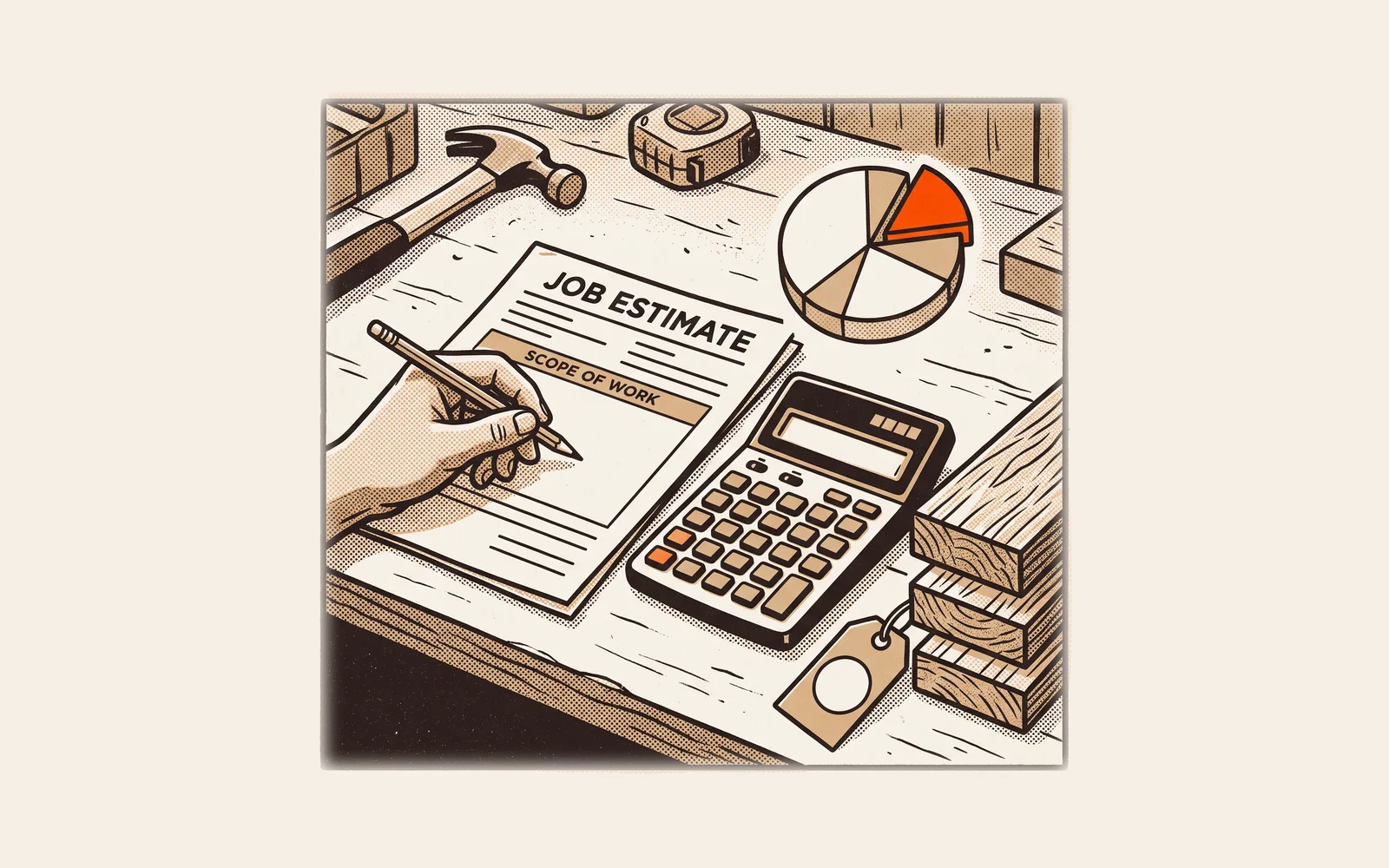
How much deposit should a contractor ask for? Deposits, draws, stage payments and state deposit laws
There is no single right deposit, and some states cap the deposit by law. Here is how to size a deposit, build a draw schedule by trade, tie stage payments to milestones, and check the rules in your state before you write the contract.

By The Revcore team
Reviewed by Hayden Mitchell, founder
Updated 12 min read

Quick answer
How much deposit should a contractor ask for?
Ask for enough to cover mobilization and your first material commitment, usually a third of the job or less. Check your state first: California caps home improvement down payments at $1,000 or 10 percent, whichever is less, and Maryland and Massachusetts cap most deposits at one-third of the contract price.
Small jobs are simple. You do the work and collect at the end. The moment a job needs a real material order and more than a few days of labor, collecting only at the end turns into a quiet cash problem. You are buying materials and making payroll for weeks before a dollar comes in. You have become the homeowner's bank, lending at zero percent while carrying all the risk.
A deposit plus a staged payment schedule fixes this. Money comes in as the work goes out, so your spending and your collections stay roughly in step. The catch is that deposits are one of the most regulated parts of a home improvement contract. Before you pick a percentage, you need to know whether your state already picked one for you.
Deposits, stage payments and draws: what each one is for
People use these words loosely, but they do different jobs. Knowing the difference helps you build a schedule that matches when you actually spend money.
| Payment | When it is collected | What it pays for |
|---|---|---|
| Deposit (down payment) | At signing, before work starts | Holding the slot on your schedule, permits, and the first commitments you make for this job. |
| Stage payment | When a defined milestone is reached | The work and materials already in place at that milestone, like a delivered material order or a passed rough-in inspection. |
| Draw | On a set schedule or percent of completion, common on long projects | Ongoing labor and materials on jobs that run for weeks or months without one obvious milestone. |
Most residential jobs only need a deposit and one to three stage payments. Percent of completion draws suit large remodels and additions, but need more documentation.
Contractor deposit laws by state
The most common question contractors search for is whether there is a legal cap on deposits in their state. Many states set no fixed percentage, but several large ones do, and others add conditions like permit deadlines or escrow rules. The table below covers states we verified against the statute itself on the official legislature site.
| State | What the law says about deposits | Source |
|---|---|---|
| California | The down payment on a home improvement contract may not exceed $1,000 or 10 percent of the contract amount, whichever is less. Progress payments may not exceed the value of the work performed or material delivered. | Bus. and Prof. Code 7159.5 |
| Maryland | No payment may be demanded before the home improvement contract is signed, and the deposit may not exceed one-third of the contract price. | Bus. Reg. 8-617 |
| Massachusetts | On residential contracts over $1,000, a deposit before work starts may not exceed the greater of one-third of the total contract price or the actual cost of special order or custom materials that must be ordered in advance. | M.G.L. c. 142A, s. 2 |
| Florida | No fixed cap, but a contractor who takes more than 10 percent up front on residential work must apply for permits within 30 days and start work within 90 days after permits issue, unless there is just cause or the homeowner agrees in writing. | Fla. Stat. 489.126 |
| New York | No fixed cap, but payments received before completion must be deposited under the lien law, or you must post a bond or similar guarantee. Contracts with progress payments must list each amount and the stage of work it is tied to. | Gen. Bus. Law 771 |
Three things trip contractors up. First, the rules usually apply to residential home improvement contracts, and the definition of that phrase differs by state. Second, some caps change with the job: Massachusetts lets the deposit cover special order materials, and Florida's conditions only apply above 10 percent. Third, California's cap is strict enough that the usual one-third deposit is simply not allowed on most jobs. On a $30,000 California remodel, the down payment tops out at $1,000.
If your state is not listed, do not assume there is no rule. Search your state legislature's site for the home improvement or contractor licensing chapter, or call your licensing board. Verify against the statute itself, not a third-party summary, because summaries go stale when laws change.
How to size the deposit when your state allows it
Where there is no cap, or the cap is generous, size the deposit to your real exposure on the job. The deposit is not profit. It is protection against the costs you take on the moment you sign.
- Mobilization. Permits, dumpster, equipment rental and the time to schedule the crew.
- Custom or special order material. Anything you cannot return, like custom windows, cabinets or a specific shingle color, is the strongest case for a larger deposit.
- Schedule risk. A signed job takes a slot you could have sold to someone else. The deposit makes a late cancellation cost the homeowner something.
- Homeowner seriousness. A homeowner who pays a deposit has made a decision. One who signs without paying often has not.
As a rule of thumb, keep the deposit close to your committed costs at signing. Far more reads as a warning sign to homeowners. Far less leaves you funding the job.
Stage payments tied to milestones, not dates
The cleanest schedules are tied to visible progress, not the calendar. If a payment is due on the fifteenth but rain put the job a week behind, you have an awkward conversation. If a payment is due when the materials are delivered, the trigger is obvious to everyone.
List your cash outflows in order
Write down when you pay for the permit, the material order, the crew and any subs. Your biggest outflows are usually the material order and payroll.
Pick a milestone just before each big outflow
Choose checkpoints the homeowner can see: materials delivered, tear-off complete, rough-in inspection passed, cabinets set. Each one should be easy to confirm with a photo.
Assign an amount to each milestone
Match each payment to the value of the work and materials in place at that point. In California this is required by law, and elsewhere it is simply the fair way to do it.
Keep a meaningful final payment
Hold back enough for the final walkthrough that the homeowner stays engaged, but not so much that one dispute over a punch list item leaves you short on the whole job.
Write it into the contract
Put every payment, its dollar amount and its trigger in the contract the homeowner signs. New York requires progress payment amounts and stages to be spelled out, and it is good practice everywhere.
Draw schedules by trade: illustrative examples
The schedules below are illustrative examples to show structure, not recommendations for your state. Each one assumes no deposit cap. In a state like California, the deposit shrinks to the legal limit and the milestone payments carry more of the load, with each one limited to the value of work done or materials delivered.
| Trade and job | Deposit at signing | Stage payments | Final payment |
|---|---|---|---|
| Roof replacement, 2 to 3 days | 20 to 33 percent | Balance due when materials are delivered and tear-off begins, or none | Remainder at completion and cleanup |
| HVAC system replacement | 25 to 33 percent | Optional payment when equipment is delivered | Remainder at startup and commissioning |
| Plumbing repipe | 20 to 30 percent | Payment at rough-in inspection passed | Remainder after fixtures, patch and final inspection |
| Electrical panel and rewire | 20 to 30 percent | Payment at rough-in inspection passed | Remainder after final inspection |
| Kitchen remodel, 6 to 10 weeks | 25 to 33 percent | Demo complete, rough-ins passed, cabinets set, countertops installed | 10 percent at final walkthrough |
| Siding and windows | 33 percent, or cost of custom windows where allowed | Payment when windows arrive | Remainder at completion |
Worked example: a kitchen remodel
Take an illustrative $60,000 kitchen remodel in a state with no deposit cap. A schedule might be $15,000 at signing to cover the design deposit on cabinets and the permit, $12,000 when demolition is complete, $12,000 when rough-in inspections pass, $15,000 when cabinets are set and countertops are templated, and $6,000 at the final walkthrough. Each payment lands just before a big cost: the cabinet order, the subcontractors, the countertop fabricator.
The same job in California would start with a $1,000 down payment. From there the milestones carry the cash, and each payment can only cover work already done or materials already delivered, so you schedule more frequent, smaller payments and time material deliveries so they can be billed as they arrive.
Worked example: a roof replacement
On an illustrative $18,000 roof that takes two days, a long draw schedule adds paperwork without much benefit. A common structure is a deposit at signing and the balance at completion. If your material cost is high and your state allows it, a second payment when the shingles land on the roof keeps you from floating the supply house for a week.
Collect the deposit at signing
A deposit you ask for is not a deposit you have. When the homeowner signs and then promises to mail a check, the job sits in limbo and your schedule slot is tied up. The cleanest moment to collect is the same moment they sign, while you are both still at the kitchen table.
- Put the deposit on the signature screen. When the contract and the deposit are one step, the homeowner does not have to make a second decision later.
- Offer card and ACH. Card is fast for smaller deposits. ACH usually costs less on large ones, and some homeowners prefer it for big numbers.
- Send a receipt immediately. A clear receipt showing the deposit amount and the remaining schedule answers questions before they turn into calls.
- Mind the cancellation window. Under the FTC Cooling-Off Rule, many sales made in the home of $25 or more can be canceled until midnight of the third business day, and the seller has 10 days to refund. State rules can add more.
Make every stage payment easy to collect
A staged schedule only helps if each payment arrives on time. When a milestone is reached, the request should go straight to the homeowner's phone with the amount already set by the contract, along with a photo of the milestone. If every stage payment turns into a separate chase by phone, the benefit disappears and your office spends its week collecting.
Changes need the same discipline. When the homeowner adds work mid-job, write a change order with its own price and its own payment terms, and get it signed before the extra work starts. Otherwise the final payment becomes the place where every unpriced change gets argued over.
Mistakes that leave you funding the job
- Starting work before the deposit clears. In Maryland, taking any payment before the contract is signed is itself prohibited. Everywhere, starting before you are paid removes your leverage.
- Letting change orders ride to the end. Unpaid extras pile onto the final payment and turn a small holdback into a big dispute.
- A final payment that is too large. If most of the job's profit sits in the last payment, one punch list disagreement puts it at risk.
Frequently asked questions
Is there a legal cap on contractor deposits in my state?
Some states have one. California limits home improvement down payments to $1,000 or 10 percent, whichever is less, and Maryland and Massachusetts cap most deposits at one-third. Florida and New York attach conditions instead of a cap. Rules vary by state and job type, so check your statute or licensing board.
What is a normal deposit for a contractor?
There is no single standard. Where no law caps it, a practical rule of thumb is a third of the job or less. The better way to decide is to cover your committed costs at signing, like permits and special order materials, rather than picking a round number.
How should draws be scheduled on a remodel?
Tie each draw to a milestone the homeowner can see, like demolition complete, rough-in inspections passed, cabinets set and final walkthrough. Place each payment just before a big cost such as a material order or a subcontractor, and write every amount and trigger into the signed contract.
What happens to the deposit if the homeowner cancels?
It depends on timing and your state. Within a federal or state cooling-off period, the homeowner can usually cancel for a full refund, and under the FTC rule the seller has 10 days to refund. After that, your contract and state law decide what you can keep, so have an attorney review your cancellation terms.
Can I ask for the full cost of materials up front?
Only where your state allows it. Massachusetts lets the deposit cover special order or custom materials that must be ordered in advance, even above one-third. California does not, since progress payments cannot exceed the value of work performed or material delivered. Check your state's rule for your job type.
Further reading: the Federal Trade Commission's guide to the Cooling-Off Rule explains the three-day cancellation right. For collecting the balance faster once the work is done, see how to get paid on the day of the job, and for closing at the table, see good, better, best pricing.
Written by the Revcore team. Reviewed by Hayden Mitchell, founder of Revcore Pro, who closed $3.5M of home improvement door to door and helped scale a contractor from $1M to $10M.